
Introduction
What if you could quickly estimate how long it will take for your money to double without using a complicated calculator?
That is exactly what the Rule of 72 helps you do.
The Rule of 72 is one of the simplest and most useful concepts in personal finance and investing. Whether you are saving money, investing in stocks, building a retirement fund, or simply trying to understand compound interest, this rule can help you make smarter financial decisions.
In this guide, you'll learn what the Rule of 72 is, how it works, where it comes from, its advantages and limitations, and real-life examples of how investors use it every day.
What Is the Rule of 72?
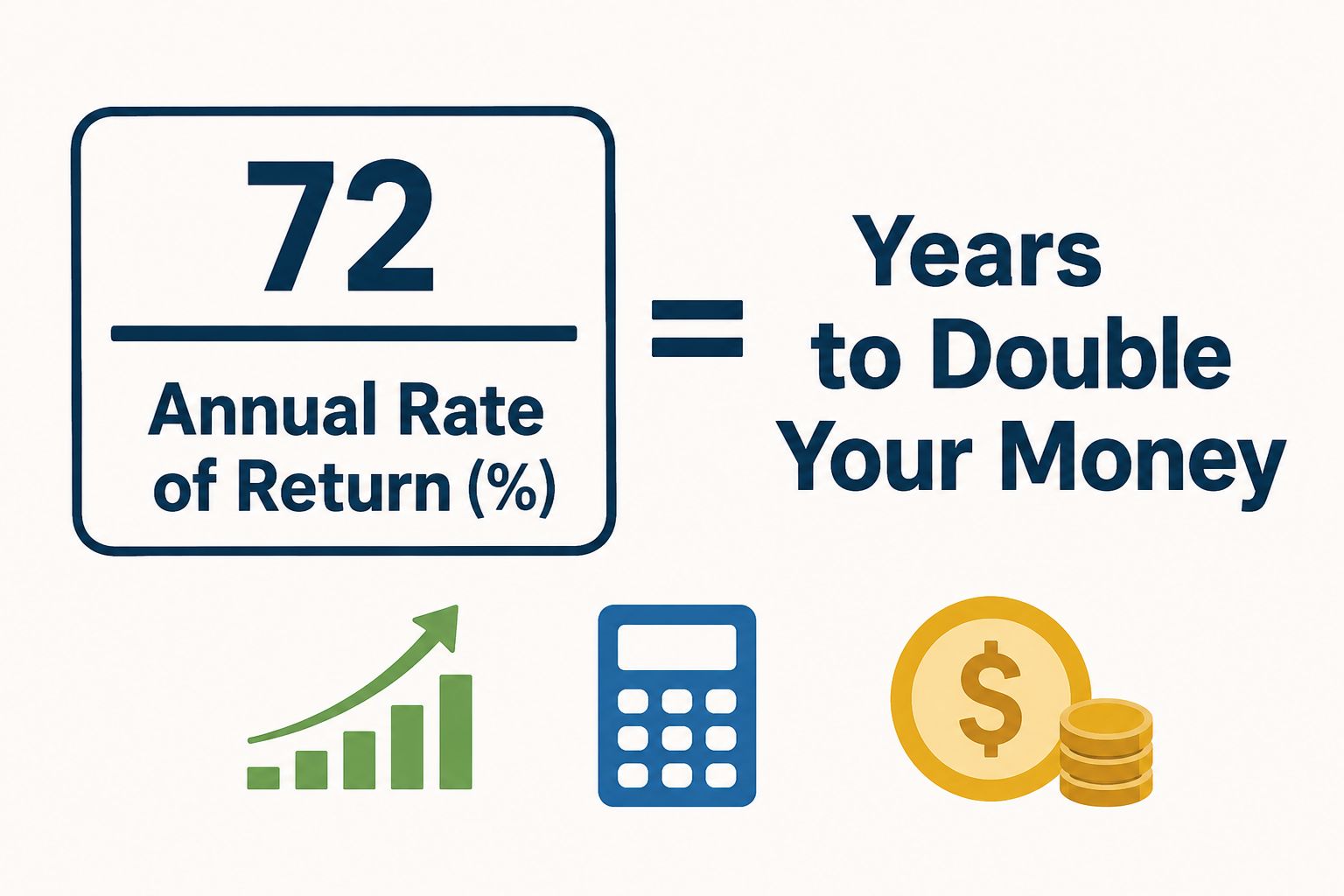
The Rule of 72 is a simple mathematical formula used to estimate how many years it will take for an investment to double in value at a fixed annual rate of return.
The formula is:
Years to Double = 72 ÷ Interest Rate
For example, if your investment earns 8% per year:
72 ÷ 8 = 9
This means it will take approximately 9 years for your money to double.
The Rule of 72 provides a quick estimate and works best with interest rates between 6% and 10%.
Why Is the Rule of 72 Important?
Many people struggle to understand how compound interest works. The Rule of 72 makes it easy to visualize investment growth without complex calculations.
It helps investors:
- Estimate investment growth quickly
- Compare different investment opportunities
- Understand the power of compound interest
- Plan long-term financial goals
- Evaluate the impact of inflation
Because of its simplicity, the Rule of 72 is widely taught in finance, economics, and investing courses.
How the Rule of 72 Works
The concept is based on compound interest, which means you earn returns not only on your original investment but also on previous earnings.
Let's say you invest $10,000 at an annual return of 8%.
Using the Rule of 72:
72 ÷ 8 = 9 years
After about 9 years:
$10,000 becomes approximately $20,000.
After another 9 years:
$20,000 becomes approximately $40,000.
After another 9 years:
$40,000 becomes approximately $80,000.
This demonstrates how compound growth can significantly increase wealth over time.
---
Rule of 72 Examples
Example 1: 6% Return
72 ÷ 6 = 12
Your money will double in approximately 12 years.
Example 2: 8% Return
72 ÷ 8 = 9
Your investment doubles in about 9 years.
Example 3: 10% Return
72 ÷ 10 = 7.2
Your money doubles in roughly 7 years.
Example 4: 12% Return
72 ÷ 12 = 6
Your investment doubles in approximately 6 years.
Rule of 72 Table
Annual Return Years to Double
2% 36 Years
3% 24 Years
4% 18 Years
5% 14.4 Years
6% 12 Years
7% 10.3 Years
8% 9 Years
9% 8 Years
10% 7.2 Years
12% 6 Years
15% 4.8 Years
This table shows how even a small increase in returns can dramatically reduce the time needed to double your money.
The Power of Compound Interest
Albert Einstein is often credited with calling compound interest the "eighth wonder of the world," although the quote's origin is debated.
Regardless of who said it, the message remains true.
Compound interest allows wealth to grow faster because earnings generate additional earnings over time.
Imagine two investors:
Investor A
Invests $10,000 at 5%.
Money doubles every 14.4 years.
Investor B
Invests $10,000 at 10%.
Money doubles every 7.2 years.
After several decades, Investor B could have significantly more wealth due to the higher growth rate.
The Rule of 72 helps investors understand this difference immediately.
Using the Rule of 72 for Retirement Planning
Retirement planning is one of the most common uses of the Rule of 72.
Suppose you expect your retirement portfolio to earn 8% annually.
Using the Rule:
72 ÷ 8 = 9
Your retirement savings could potentially double every 9 years.
If you are 35 years old and plan to retire at 62, your money could double about three times during that period.
A $50,000 investment could potentially grow to:
- $100,000 after 9 years
- $200,000 after 18 years
- $400,000 after 27 years
This demonstrates why starting early can make such a big difference.
Using the Rule of 72 to Understand Inflation
The Rule of 72 can also estimate how quickly inflation reduces purchasing power.
For example, if inflation averages 4% annually:
72 ÷ 4 = 18
This means the purchasing power of your money could be cut in half in about 18 years.
Something that costs $100 today could effectively feel like $200 in the future due to rising prices.
Understanding inflation helps investors make informed decisions about saving and investing.
Rule of 72 in Real Estate
Real estate investors often use the Rule of 72 to estimate property appreciation.
Suppose property values in an area increase by 6% annually.
72 ÷ 6 = 12
Property values could potentially double in about 12 years if the growth rate remains consistent.
While real estate markets can fluctuate, the Rule of 72 provides a useful estimate for long-term planning.
Rule of 72 in Stock Investing
Stock investors frequently use the Rule of 72 when evaluating potential returns.
Historically, major stock market indexes have delivered average annual returns around 8% to 10% over long periods.
At:
- 8% return → Money doubles in about 9 years
- 10% return → Money doubles in about 7.2 years
This helps investors understand the long-term benefits of staying invested.
Advantages of the Rule of 72
Easy to Use
No advanced math skills are required.
Quick Estimates
You can calculate doubling time in seconds.
Useful for Financial Planning
It helps with retirement, investing, and savings goals.
Demonstrates Compound Growth
The formula clearly shows the impact of earning higher returns.
Helps Compare Investments
Investors can quickly evaluate different opportunities.
Limitations of the Rule of 72
While useful, the Rule of 72 is not perfect.
It Is Only an Estimate
Actual results may differ slightly.
Assumes Constant Returns
Markets rarely provide the same return every year.
Less Accurate at Extreme Rates
The rule works best with moderate interest rates.
Does Not Consider Taxes or Fees
Investment expenses can reduce actual returns.
Because of these limitations, the Rule of 72 should be viewed as a planning tool rather than an exact prediction.
Rule of 72 vs. Rule of 70
Some financial experts also use the Rule of 70.
Formula:
Years to Double = 70 ÷ Interest Rate
The Rule of 70 is sometimes considered slightly more accurate for lower growth rates.
However, the Rule of 72 remains more popular because it is easier to divide by common interest rates such as 6%, 8%, 9%, and 12%.
Tips to Double Your Money Faster
If your goal is to grow wealth more quickly, consider the following strategies:
Invest Early
Time is one of the most powerful factors in investing.
Reinvest Earnings
Allow dividends and interest payments to compound.
Increase Contributions
Regular investments can accelerate growth.
Focus on Long-Term Growth
Avoid making emotional investment decisions.
Minimize Fees
Lower fees mean more money stays invested.
Common Mistakes Investors Make
Many investors underestimate the importance of compounding.
Common mistakes include:
- Starting too late
- Withdrawing investments too early
- Chasing short-term gains
- Ignoring inflation
- Keeping too much cash for long periods
The Rule of 72 highlights how small differences in returns can create large differences in future wealth.
Frequently Asked Questions
Is the Rule of 72 accurate?
It is generally accurate for estimating doubling time when interest rates are moderate and returns are compounded annually.
Can the Rule of 72 be used for inflation?
Yes. It can estimate how long it takes for inflation to cut purchasing power in half.
Does the Rule of 72 work for stocks?
Yes. Investors often use it to estimate how quickly investments may double based on average annual returns.
Who invented the Rule of 72?
The concept has been used for centuries and is often linked to early mathematical studies of compound interest.
Why is the number 72 used?
The number 72 has many divisors, making mental calculations easier and reasonably accurate.
Conclusion
The Rule of 72 is one of the simplest and most powerful tools in personal finance. By dividing 72 by an annual interest rate, investors can quickly estimate how long it will take for money to double.
Whether you're saving for retirement, investing in stocks, buying real estate, or protecting yourself from inflation, understanding the Rule of 72 can help you make smarter financial decisions.
The lesson is simple: higher returns and more time can dramatically increase wealth through compound growth. The sooner you start investing and allowing your money to compound, the greater the potential rewards in the future.



No comments yet.